

From Q4 2025 through Q1 2026, the AWALL research team analyzed data from eight leading market research reports and two primary industry sources, including Future Market Insights, Coherent Market Insights, Omdia, Mordor Intelligence, and the Lutron Luxury Residential 2026 Trend Report, along with product announcements from CES 2026 and CEDIA 2025, to assess the key drivers, technology benchmarks, and design behaviors shaping the global home theatre system market, with a focus on the premium segment serving high-net-worth residential builds in North America (N.A.) and Western Europe.
According to Future Market Insights, the global home theatre system market is valued at USD 13.99 billion in 2026 and is projected to reach USD 34.67 billion by 2036, registering a CAGR of 9.5% over the forecast period.1 This article examines the five most significant, metrics-backed trends defining luxury home theatres in 2026, offering industry benchmarks, insights from leading brands, and actionable guidance for designers, integrators, and homeowners planning premium builds or upgrades.
The 5 Top Luxury Home Theatre Trends in 2026
The table below presents the five defining luxury home theatre trends of 2026, mapped to their corresponding market values, growth rates, and primary drivers.
The 5 Defining Luxury Home Theatre Trends in 2026: Market Size, Growth Rates, and Key Drivers
| Trend | 2026 Market Value | Growth Rate (CAGR) | Primary Driver |
|---|---|---|---|
| Architectural and Invisible Audio | USD 6.08B9 | 7.57%9 | Design-led demand for invisible speakers; professional installation as standard |
| Spatial Audio | USD 4.64B5 | 15.2% (to 2033)5 | Streaming platforms adopting spatial audio for live sports and premium content |
| AI-Driven Automation and Smart Control | USD 4.61B6 | 7.2% (to 2035)6 | AI personalization, privacy-first local processing, unified control ecosystems |
| MicroLED and RGB Mini-LED Displays | USD 1.49B34 | 35.4% (to 2033)34 | Ambient-light performance; bespoke modular sizing for large-format luxury rooms |
| Human-Centric Lighting and Automated Shading | USD 9.21B11 | 15.5% (to 2030)11 | 94% of designers rate lighting as highly important; 56% include automated shades in final designs2 |
Key Takeaways
- Lighting and Shading Lead by Market Size: The North American residential lighting control system market at USD 9.21 billion11 is the largest single segment across the five trends, reflecting how deeply wellness design has been built into the luxury build specification.
- MicroLED Leads by Growth Rate: With a 35.4% CAGR4, MicroLED is the fastest-growing technology across all five trends and the highest-velocity display investment in the luxury segment.
- All Five Trends Point in the Same Direction: Integration, invisibility, and personalization are the shared values across display, audio, automation, and design. The luxury home theatre of 2026 is defined by how seamlessly technology enhances the space, whether that means hiding the audio entirely or making a massive MicroLED display the architectural centerpiece of a sunlit room.
Trend 1: MicroLED and the New Display Standard
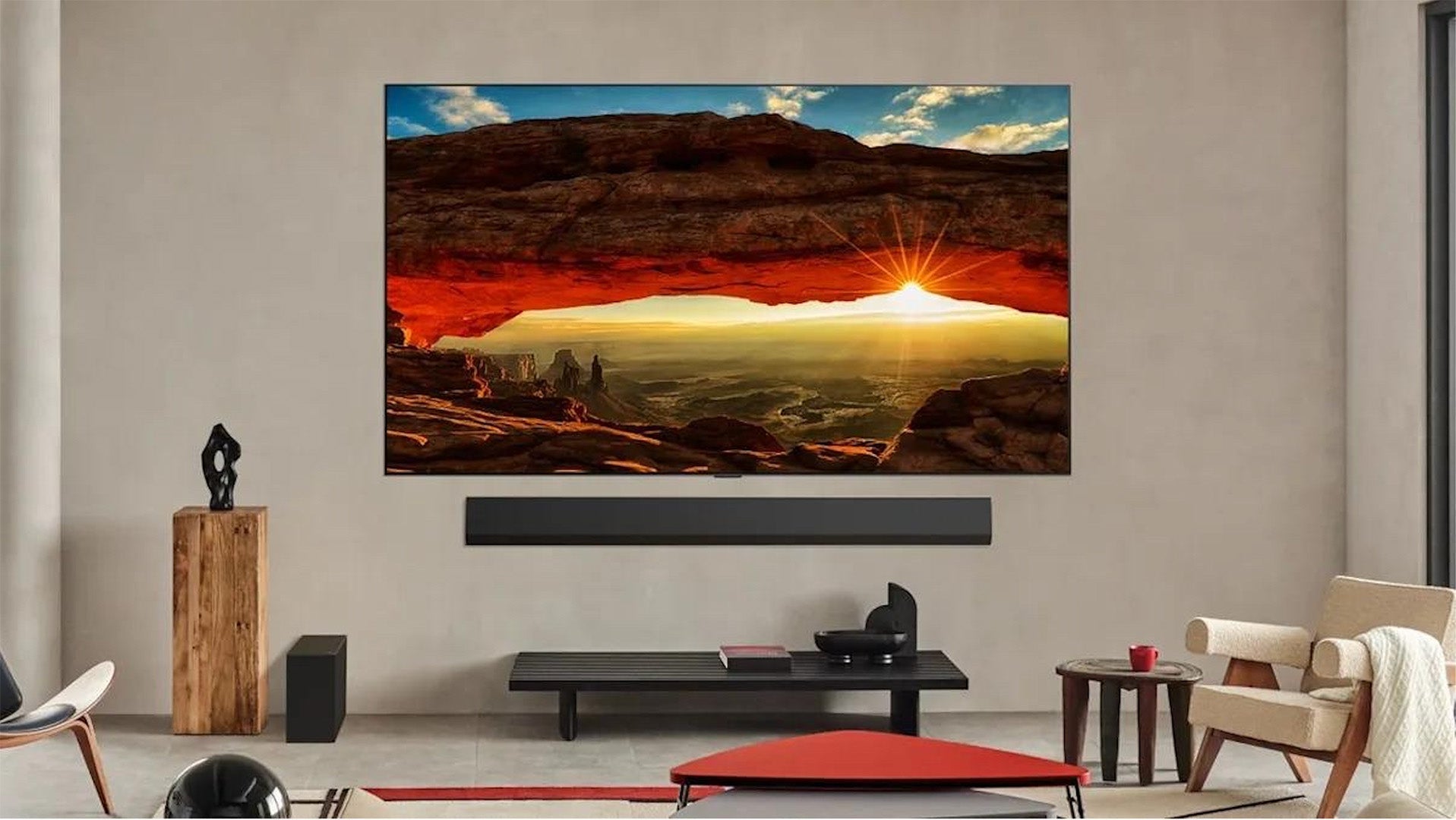
The dominance of OLED in the premium display market is facing a direct challenge from Micro-LED and RGB Mini-LED technologies. CES 2026 marked a clear turning point, with Samsung, LG, AWALL, Sony, Hisense, and TCL all unveiling displays that use full red, green, and blue sub-pixels for greater color accuracy, peak brightness, and contrast. These advances matter most for luxury home theatres because large-format, high-brightness displays enable multi-purpose spaces that perform well in ambient light, removing the traditional requirement of a fully blacked-out room.
The global Micro-LED market is growing at a 35.4% CAGR and is projected to surpass USD 13.56 billion by 2033. Omdia projects that Micro-LED display revenue will double from USD 52.4 million in 2025 to USD 105.4 million in 2026. The global OLED TV market remains the dominant incumbent in the premium display segment, valued at USD 100.04 billion in 2026 and growing at a 12.97% CAGR through 2035, yet at a third the growth rate of MicroLED, its position as the default luxury display choice is being actively challenged. The home theatre projector market is valued at USD 6.33 billion in 2026, with laser projection growing at a 16.62% CAGR through 2032.
Display Technology Comparison for Luxury Home Theatres (2026)
| Technology | Typical Screen Size | 2026 Market Value / Revenue | Growth Rate | Luxury Price Range |
|---|---|---|---|---|
| MicroLED (CoB) | 108" to 163"+ (modular) | USD 1.49B market4 | 35.4% CAGR3 | $40,000 -- $250,000+ |
| Mini-LED |
65" to 115" | USD 10.15B market14 | 18.1% CAGR to 2034 | $2,000 -- $20,000+ |
| OLED | 55" to 97" | USD 100.4B14 | 12.97% CAGR (to 2035)14 | $3,000 -- $30,000+ |
| Laser Projector | 100" to 300" | USD 6.33B (projector market)8 | 16.62% CAGR (to 2032)8 | $5,000 -- $80,000+ |
Key Takeaways
- MicroLED Leads Growth: With a 35.4% CAGR and 100% YoY revenue growth34, MicroLED is the fastest-growing display technology in the luxury segment.
- Mini-LED is the High-Growth Mid-Market: The global Mini-LED TV market is valued at USD 10.15 billion in 2026 and growing at an 18.1% CAGR, making it the most accessible entry point into large-format, high-brightness luxury display.
- OLED Dominates Sub-100": The $100.04B OLED TV market (12.97% CAGR) confirms its hold on traditional premium TV sizes, though it is growing at a third the pace of MicroLED.
- Projectors Retain Niche: The USD 6.33B laser projector market8 (16.62% CAGR) shows sustained demand for large screens in dedicated, light-controlled rooms.
Trend 2: Architectural and Invisible Audio
The aesthetic requirement for luxury home audio in 2026 is clear: sound should be felt, not seen. Demand for architectural speakers, including in-wall, in-ceiling, and fully invisible solutions, is growing as homeowners work to remove visual clutter without reducing acoustic performance. This reflects a broader design principle in which technology integrates into the architecture rather than sitting in front of it.
The premium home theatre audio systems market is forecast to reach USD 6.08 billion in 2026 at a 7.57% CAGR. The global in-wall speakers market grew from USD 1.85 billion in 2025 to USD 2.01 billion in 2026, a rate of 8.6% year over year. Specialty stores and professional installation channels hold a 56.5% share of premium audio distribution, driven by the need for consultation and calibration. According to CEDIA, mid-range home theatre installations range from USD 13,000 to USD 32,000, while high-end luxury installs start at USD 65,000.
Audio Technology Adoption Benchmarks for Luxury Home Theatres (2026)
| Audio Metric | 2025 Value | 2026 Value | Growth Rate / CAGR | Context |
|---|---|---|---|---|
| Premium Home Theatre Audio Systems Market | USD 5.65B9 | USD 6.08B9 | 7.57% CAGR9 | Consistent growth driven by premium multi-component system demand |
| Global In-Wall Speakers Market | USD 1.85B9 | USD 2.0B9 | 8.6% YoY / 8.5% CAGR to 20339 | Growing faster than the overall audio segment; confirms aesthetic integration as primary purchase driver |
| Global Wireless Audio Device Market | USD 55.36B5 | USD 64.76B5 | 20.4% CAGR to 20335 | Wireless adoption removing installation friction and enabling modular speaker configurations |
| Spatial Audio TV Market | USD 4.03B5 | USD 4.64B5 | 15.2% CAGR to 20335 | Spatial audio moving from premium upgrade to baseline expectation |
| Spatial-Ready Multi-Component Systems Share | 18% -- 28% | 18% -- 28% | 0% | Significant runway remaining for integrators and homeowners who have not yet upgraded |
| Specialty Store / Pro-Install Channel Share | 56.5%1 | 56.5%1 | 0% | Confirms this is a professionally mediated, consultation-driven market |
Key Takeaways
- Invisible Audio Outpaces Traditional: The in-wall speaker market (8.6% YoY) is growing faster than the broader premium audio market (7.57% CAGR)9, confirming aesthetic integration as the primary driver.
- Wireless is Accelerating: The wireless audio device market's 20.4% CAGR5 reflects a strong shift away from traditional wired installations.
- Pro-Install Remains Dominant: With 56.5% of sales through specialty and pro-install channels1, expert integration is standard for luxury audio.
Trend 3: Spatial Audio as the Baseline Standard
Dolby Atmos and other spatial audio formats have moved from premium upgrades to baseline expectations in luxury home theatres. The shift is no longer about whether to include three-dimensional sound; it is about how to configure it. Object-based audio anchors sound to on-screen content, moves it naturally through the room, and adapts to the space's acoustic characteristics. CES 2026 confirmed that spatial audio is no longer a differentiator in the luxury segment; it is the starting point.
The global wireless audio device market is projected at USD 64.76 billion in 2026, growing at a 20.4% CAGR through 2033. The spatial audio TV market reached USD 4.64 billion in 2026 and is projected to reach USD 12.6 billion by 2033 at a 15.2% CAGR. Between 18% and 28% of multi-component speaker systems currently sold are spatial-audio ready, indicating a large portion of the installed base has yet to upgrade. Peacock became the first streaming platform to deploy spatial audio and high dynamic range across live sports in 2026, accelerating content-driven hardware upgrade cycles.
Spatial and Wireless Audio Market Metrics
| Metric | 2025 Value | 2026 Value | Projected Growth / CAGR |
|---|---|---|---|
| Global Wireless Audio Device Market | USD 55.36B5 | USD 64.76B5 | 20.4% CAGR (to 2033)5 |
| Spatial Audio TV Market Size | USD 4.03B5 | USD 4.64B5 | 15.2% CAGR (to 2033)5 |
| Global Audio Streaming Market | USD 40.1B5 | USD 45.2B5 | 12.5% CAGR (to 2033)5 |
| U.S. Wireless Audio SoC Market | USD 1.20B5 | USD 1.37B5 | 14.7% CAGR (2026-2033)5 |
| Spatial-Ready Multi-Component Systems Share | 18% -- 28% | 18% -- 28% | 0% |
Key Takeaways
- Spatial Audio is the New Baseline: The spatial audio TV market is growing at a 15.2% CAGR5, confirming that 3D object-based sound is now the standard expectation, not a premium add-on.
- Wireless Infrastructure is Expanding: The 20.4% CAGR in wireless audio devices5 and 14.7% CAGR in wireless audio SoCs point to a future of cable-free, modular speaker configurations.
- Significant Upgrade Runway: With spatial-ready multi-component systems at only 18% to 28% share5, the majority of the installed base has yet to upgrade.
Trend 4: AI-Driven Personalization and Seamless Smart Automation
Artificial intelligence is redefining how homeowners interact with their entertainment systems. In 2026, smart automation has moved beyond scheduled scenes and remote control. AI-powered platforms offer predictive, context-aware personalization that learns preferences, anticipates needs, and connects the home theatre to every other system in the home. Platforms like Josh.ai, Control4, and Savant are leading this category, with Josh.ai's privacy-first, local processing approach serving as a notable differentiator for high-net-worth clients sensitive to data security.
The North American (N.A.) ultra-luxury home automation market is estimated at USD 4.3 billion in 2025, growing at a 7.2% CAGR through 2035. The global voice control smart home market was valued at more than USD 134.5 billion in 2025 and is growing at a 27.9% CAGR. The U.S. voice AI in smart homes sub-segment is expanding at a 44.8% CAGR, the fastest growth rate across all five trends analyzed in this report. Home entertainment integrated with smart home systems is growing at a 24.1% CAGR, and 78% of home buyers express interest in smart home features.
Smart Home Automation Adoption Metrics for Luxury Home Theatres (2026)
| Metric / Feature | 2025 Value | 2026 Value | Growth Rate / CAGR | Context |
|---|---|---|---|---|
| N.A. Ultra-Luxury Home Automation Market | USD 4.30B6 | USD 4.61B6 | 7.2% CAGR to 20356 | Steady growth anchored by premium AV and integrated control systems |
| Global Voice Control Smart Home Market | USD 134.5B7 | USD 172.0B7 | 27.9% CAGR7 | Natural language platforms driving luxury segment adoption |
| U.S. Voice AI in Smart Homes Market | USD 5.53B7 | USD 8.00B7 | 44.8% CAGR7 | Fastest-growing sub-segment; AI personalization layer accelerating above base automation |
| Home Entertainment in Smart Homes | USD 47.70B7 | USD 59.19B7 | 24.1% CAGR7 | AV integration with lighting, climate, and shading driving combined spend |
| Home Buyers Interested in Smart Features | 78%7 | 78%7 | N/A -- established baseline | Confirms automation as a residential value driver across the broader market |
| Smart Device Owner Satisfaction Rate | 97%7 | 97%7 | N/A -- established baseline | Per Smart Energy Consumer Collaborative (SECC), 97% of owners are satisfied |
Key Takeaways
- Voice AI is the Growth Engine: The U.S. Voice AI in Smart Homes market is expanding at a 44.8% CAGR7, well ahead of the broader ultra-luxury automation market at 7.2% CAGR6.
- Entertainment Drives Smart Home Spend: Home entertainment integrated into smart homes is growing at a 24.1% CAGR7, placing AV as a primary catalyst for automation investment.
- High Satisfaction and Demand: 78% of buyers express interest in smart features7 and 97% of current owners report satisfaction7, confirming automation as a proven value-add for luxury.
Trend 5: Human-Centric Lighting, Automated Shading, and Wellness-Oriented Design
Luxury home theatre design in 2026 is shaped by wellness principles. Lighting and automated shading are now foundational architectural decisions, not finish-stage selections. They shape mood, support circadian health, and determine the quality of the viewing experience. At the same time, theatre interiors are moving toward natural, organic materials, warm neutral tones, and textured surfaces, replacing the glossy, high-contrast aesthetics of earlier decades.
The North American residential lighting control system market is valued at USD 9.21 billion in 2026, growing at a 15.5% CAGR through 2030. Lutron's 2026 Luxury Residential Trend Report, informed by Harris Poll surveys of high-net-worth homeowners and residential designers, reports that 94% of designers consider lighting highly important to their clients, 47% report that poor lighting devalues even premium finishes, 56% include automated shades in their final designs, and 61% include app-controlled lighting in their specifications.
Luxury Home Theatre Lighting and Wellness Design Benchmarks (2026)
| Design Element | Metric or Adoption Rate | Key Finding |
|---|---|---|
| Lighting Importance to Clients | 94% of designers and architects2 | Lighting is an overwhelming design priority across luxury residential projects |
| Automated Shades Included in Final Designs | 56% include; 43% additionally recommend2 | Motorized shading has shifted from optional upgrade to expected design standard |
| Smartphone / App-Controlled Lighting | 61% of designers include2 | Smart lighting control is a baseline design expectation in the luxury segment |
| North America Residential Lighting Control System Market | USD 9.21 Billion / 15.5% CAGR (to 2030)11 | Rapid growth driven by smart home integration and energy-efficiency regulations |
Key Takeaways
- Lighting is the Top Design Priority: 94% of designers report lighting is highly important2, and 47% warn that poor lighting devalues high-end finishes2.
- Automated Shading is Standard: 56% of designers now include automated shades in their final designs2, confirming it as a baseline requirement for luxury spaces.
- Smart Control is Expected: 61% of designers include app-controlled lighting2, and 60% of homeowners already adjust lighting by mood or time of day2.
What the Data Means for Home Theatre Trends for Luxury Homes
The market data confirms one direction across all five trends: the luxury home theatre of 2026 is built to be a living, adaptive space, not a fixed, single-purpose room. The fastest-growing technologies, MicroLED displays at a 35.4% CAGR, wireless spatial audio at a 20.4% CAGR, and voice AI in smart homes at a 44.8% CAGR, share a common value: they remove the physical constraints that previously defined what a home cinema had to look, sound, and function like. Lighting and shading lead by market size at USD 9.21 billion, reflecting how deeply wellness design has become integrated into the luxury build specification.
For homeowners, designers, and integrators planning builds or renovations, the data points to three non-negotiable decisions: the display technology must perform in ambient light at scale; the audio configuration must meet spatial audio as the floor standard; and the lighting and shading system must be designed from the architectural phase, not added as a finish.
See MicroLED in Your Space
AWALL's Chip-on-Board MicroLED technology was built for this moment. It combines the brightness, modular sizing, and long-term color stability that the fastest-growing display trend requires, at a price point designed to make reference-grade performance accessible without the cost barriers of legacy panelized systems. Available in 108", 135", and 162" configurations with pixel pitches from 0.9mm to 1.25mm, AWALL delivers up to 1,200 nits of brightness, a 15,000:1 native contrast ratio, and a 3840Hz refresh rate across a display that is 45% lighter and 55% thinner than comparable panelized systems.
The global home theatre system market is projected to reach USD 34.67 billion by 2036. The display technologies that will define luxury spaces over the next decade are being selected in builds and renovations happening now. To see AWALL's CoB MicroLED technology in action or to discuss sizing, configuration, and installation for a specific project, contact us or visit awall.com.
References
1. Future Market Insights. "Global Home Theatre System Market Set for Robust Growth as Smart Home Integration and Streaming Ecosystem Drive Adoption." Morningstar / Accesswire. April 14, 2026. https://www.morningstar.com/news/accesswire/1157384msn/global-home-theatre-system-market-set-for-robust-growth-as-smart-home-integration-and-streaming-ecosystem-drive-adoption-future-market-insights-fmi
2. Lutron Electronics / The Harris Poll. "Lutron Releases 2026 Luxury Residential Trend Report: Living with Light." December 9, 2025. https://www.lutron.com/us/en/press/lutron-releases-2026-luxury-residential-trend-report
3. Omdia. "Micro LED Display Revenue to Double to $105 Million Dollars in 2026." February 19, 2026. https://omdia.tech.informa.com/pr/2026/feb/micro-led-display-revenue-to-double-to-105-million-dollars-in-2026-driven-by-near-eye-smart-watch-and-public-display-applications
4. Coherent Market Insights. "Micro-LED Market Size, Trends and Forecast, 2026-2033." January 9, 2026. https://www.coherentmarketinsights.com/market-insight/micro-led-market-4419
5. Fortune Business Insights. "Wireless Audio Device Market By Device and By Technology." https://www.fortunebusinessinsights.com/wireless-audio-device-market-106904
6. Global Market Insights. "North America Ultra-Luxury Home Automation Market Size and Forecast, 2035." https://www.gminsights.com/industry-analysis/north-america-ultra-luxury-home-automation-market
7. Research Nester. "Voice Control Smart Home Market Trends and Growth Forecasts to 2035." https://www.researchnester.com/reports/voice-control-smart-home-market/5865
8. SkyQuestt. "Laser Projector Market Size, Share, Trends and Forecast 2033." https://www.skyquestt.com/report/laser-projector-market
9. Persistence Market Research / Report Prime. "Home Theater Audio Systems Market Size and Forecast to 2033." https://www.reportprime.com/premium-home-theater-audio-systems-r4324
10. Grand Research Store. "Premium Home Theater Seat Market, Global Outlook and Forecast." https://www.grandresearchstore.com/consumer-goods-and-services/global-premium-home-theater-seat-forecast-market/amp
11. Mordor Intelligence. "North America Residential Lighting Control System Market Size and Share Analysis: Growth Trends and Forecasts 2025-2030." https://www.mordorintelligence.com/industry-reports/north-america-residential-lighting-control-system-market
12. CEDIA. "Home Theater Costs." https://cedia.net
13. Market Research Future. "OLED TV Market Size, Share, Growth Report, 2035." April 6, 2026.
14. Mini-LED TV Market Research Report 2034. DataIntelo. https://dataintelo.com/report/mini-led-tv-market

Leave a comment
This site is protected by hCaptcha and the hCaptcha Privacy Policy and Terms of Service apply.