
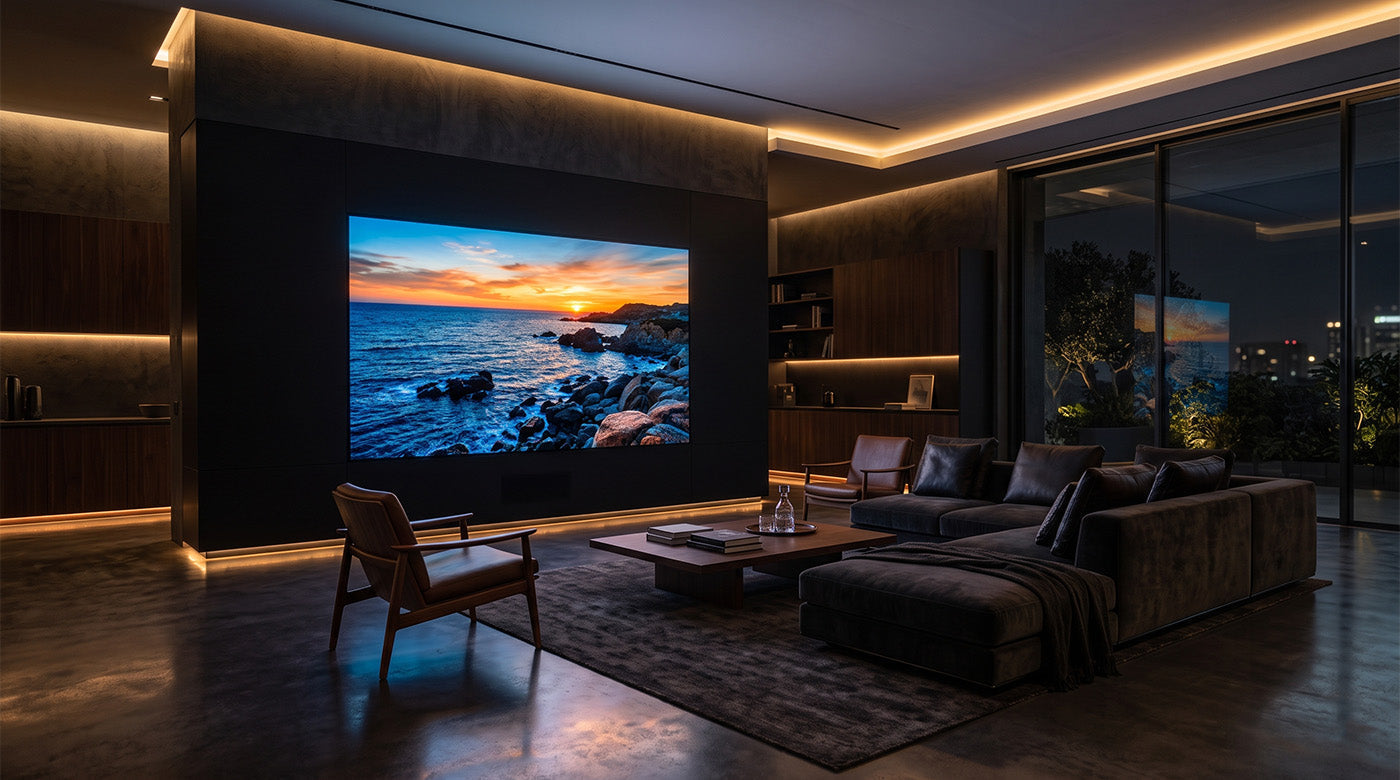
A MicroLED TV uses microscopic, self-emissive LED chips as its picture elements, rather than a backlight shining through liquid crystal (LCD) or an organic compound that emits its own light (OLED). Each inorganic chip switches on or off independently, which avoids the backlight bleed common to LCD and the organic degradation that limits OLED's lifespan. MicroLED is often confused with MiniLED, a backlit LCD technology that uses smaller LED zones for local dimming rather than a self-emissive pixel structure; the two are not the same category. Manufacturers such as AWALL have brought Chip-on-Board (CoB) MicroLED, a packaging method where each LED chip mounts directly on the board and is sealed with a protective resin, to consumer and prosumer price points once limited to ultra-luxury commercial installs. This guide walks through the 10 specifications that determine how a MicroLED display performs: pixel pitch, brightness, contrast, packaging, color depth, refresh rate, modularity, viewing angle, lifespan, and installation.
MicroLED TV Specs at a Glance
| Spec | What It Means | Typical Range | Why It Matters |
|---|---|---|---|
| Pixel Pitch | Distance between LED clusters, in mm | Roughly 0.7mm-1.2mm for consumer/prosumer units | Smaller pitch allows closer comfortable viewing |
| Brightness (Nits) | Peak vs. sustained light output | Peak: 1,000–2,500 nits; Sustained: 300–700 nits | Sustained brightness matters more than peak for daily viewing |
| Native Contrast Ratio | Luminance difference between white and black in the same frame | 10,000:1–30,000:1+ native | A more reliable indicator than marketed dynamic contrast |
| Chip-on-Board (CoB) / Flip-Chip | LED chips mounted directly on the board, sealed with protective resin | Chip size: 1µm–100µm | Improves heat dissipation and lowers power draw vs. SMD |
| Color Bit Depth | Number of shades per color channel | 88-bit to 12-bit+ (256 to 4,096+ shades/channel) | Higher bit depth reduces visible banding in gradients |
| Refresh Rate (Panel Scan Rate) | How many times per second the display's driver electronics scan and re-illuminate the panel, independent of frame rate | Standard TV panels: 60Hz-120Hz; CoB MicroLED lines: often 3,840Hz+ | Reduces visible flicker and camera banding; a separate spec from frame rate |
| Modular, Scalable Design | Tileable panels that combine into custom sizes | Preconfigured runs roughly 75″ to 160″+, custom sizing often available | Enables sizes and aspect ratios beyond fixed panel limits |
| Viewing Angle | How well color and brightness hold up off-axis | Self-emissive: minimal shift to ~170°; LCD: shift often starts ~30°–45° off-axis | Avoids the color shift common to backlit LCD |
| Operational Lifespan | Rated operating hours before meaningful degradation | 100,000+ hrs (inorganic LED) vs. 50,000–100,000 hrs (OLED) | Resists the burn-in risk organic OLED faces |
| Installation | Time and process required to mount and align the display | 4–8+ hours, scaling with size | Varies significantly by display size |
Note: figures above reflect general industry ranges for consumer and prosumer CoB MicroLED displays, not any single brand. Brand-specific figures are cited as examples within each section below.
Pixel Pitch and Resolution
Pixel pitch is the distance, in millimeters, between the centers of two neighboring LED clusters.1 A smaller number packs more pixels into the same physical area, which lets you sit closer to the screen without seeing individual dots. A larger number needs more viewing distance before the image looks smooth. Some manufacturers sell the same physical size at more than one pitch, trading price against how close a viewer can comfortably sit. AWALL, for example, offers its 135-inch model at both 1.2mm and 0.9mm pixel pitch, at two different published price points, so a buyer can choose based on their room's seating distance rather than guessing. For even closer seating, AWALL's I-Series reaches a 0.7mm pixel pitch, which by the same rule of thumb supports comfortable viewing from around 7 feet.
| Pixel Pitch | Best Suited For | Approximate Minimum Viewing Distance |
|---|---|---|
| 1.2mm-1.5mm | Larger rooms, greater seating distance | 12-15 feet or more |
| 0.9mm-1.1mm | Mid-size home theater and media rooms | 9-11 feet |
| 0.7mm-0.8mm | Closer seating, premium/prosumer installs | 7-8 feet |
Note: ranges are general guidance, not a single manufacturer's published spec; brand-specific figures were re-verified against live product pages before publishing.
Brightness: Peak Nits vs. Sustained Nits
Manufacturers quote two different brightness numbers, and mixing them up leads to unfair comparisons. Peak brightness is the brightest a small portion of the screen can get for a brief moment, used for HDR highlights like headlights or fireworks.2 Sustained, or common, brightness is how bright the full screen stays during normal viewing, and it is almost always well below the quoted peak figure. When comparing two displays, check whether the number you're looking at is peak or sustained; a lower peak paired with a higher sustained figure can look brighter in daily use than a higher peak with a low sustained figure.

| Term | What It Measures | When It Applies |
|---|---|---|
| Peak brightness | Brightest a small portion of the screen can get, briefly | HDR highlights: fireworks, headlights, sun glare |
| Sustained (common) brightness | Brightness across the full screen, held steadily | Everyday viewing: news, sports, streaming |
Native Contrast Ratio
Native contrast ratio divides a display's white luminance by its black luminance, measured on the same panel under the same conditions.3 It is a more reliable indicator than a marketed “dynamic contrast” number, which often reflects a backlight dimming trick rather than the panel's true capability. Self-emissive technologies, including MicroLED and OLED, don't need a backlight at all: a pixel that's off draws no light and produces a true black. Because true-off pixels don't fit a normal white-over-black division, native contrast on self-emissive displays is often described in true black-level terms as effectively infinite, even though the display's specific native contrast figure, for example 15,000:1, remains the number to compare against a competing panel.
| Display Type | Backlight Behavior | General Native Contrast Character |
|---|---|---|
| Standard backlit LCD | Single, uncontrolled backlight | Lower native contrast, visible gray blacks |
| Local-dimming LCD / Mini-LED | Backlight split into zones | Improved native contrast, some blooming possible |
| Self-emissive (OLED / MicroLED) | Each pixel emits or turns off individually | Very high to effectively infinite native contrast, true blacks |
Chip-on-Board (CoB) and Flip-Chip Technology
Chip-on-Board (CoB) is a packaging method where each LED chip is directly mounted on the board and sealed with a protective resin, rather than soldered into an individual surface-mount (SMD) package first.4 Flip-Chip CoB goes a step further: the chip is bonded face-down directly to the board, which removes the wire-bond connection altogether. Removing that step improves heat dissipation and lowers power draw compared with SMD packaging, since there is less material and fewer connection points between the chip and the board. As one example of how manufacturers differentiate within CoB, AWALL uses an eight-magnet per-module alignment system: eight integrated magnets per module, plus a specialized magnetic adjustment tool that lets installers fine-tune alignment and correct minor gaps after mounting. This detail is manufacturer-confirmed but not yet published on AWALL's live product pages.

| Method | Chip Connection | Relative Heat Dissipation |
|---|---|---|
| SMD | Soldered package mounted on board | Lower |
| Standard COB | Bare chip wire-bonded to board | Improved over SMD |
| Flip-Chip COB | Chip bonded face-down, no wires | Highest of the three |
Color Bit Depth
Bit depth measures how many shades a display can produce within a single color channel, which is different from color gamut, the total range of colors a display can produce at all.5 An 8-bit panel produces 256 shades per channel, for about 16.7 million total colors. A 10-bit panel produces 1,024 shades per channel, for roughly 1.07 billion total colors. The practical difference shows up as banding, visible steps in a smooth gradient like a sunset or a shadow, that a higher bit depth panel renders as a smooth transition instead.
| Bit Depth | Shades per Color Channel | Total Possible Colors |
|---|---|---|
| 8-bit | 256 | About 16.7 million |
| 10-bit | 1,024 | About 1.07 billion |
Refresh Rate
Refresh rate and frame rate are related specs, measured in the same unit, that are easy to mix up. Frame rate describes how many distinct frames per second the source content or input signal delivers; this is what most people mean when they talk about motion smoothness in sports or gaming, and it's generally 24Hz to 30Hz for film and broadcast content, and 60Hz for standard TV input signals. Refresh rate, in the LED and MicroLED display context, describes something different: how many times per second the display's driver electronics scan and re-illuminate the pixel array internally, independent of the incoming frame rate. A single 60Hz video frame can be re-illuminated dozens or hundreds of times by a high refresh rate panel before the next frame arrives. That distinction is why CoB MicroLED lines publish refresh rate figures in the thousands of Hz: a faster internal scan rate reduces visible flicker and scan lines, which matters most when the display is captured on camera, rather than changing how smooth the underlying video content looks. AWALL, for example, supports a 60Hz frame rate for incoming video signal, which is a separate spec from its panel's internal refresh rate.

| Category | Typical Refresh Rate |
|---|---|
| Standard consumer TV | 60Hz-120Hz |
| High-end gaming monitor | 144Hz-240Hz |
| CoB MicroLED display lines | Often published in the thousands of Hz |
Modular, Scalable Design
MicroLED displays are built from individual tileable panels, or modules, that combine edge-to-edge into a single seamless display.6 Because the display is assembled from modules rather than manufactured as one fixed panel, it can be built in sizes and aspect ratios a fixed-panel TV cannot reach. Preconfigured runs are common industry-wide, typically from around 75 inches up to 160 inches or more, with custom sizing often available beyond that. As one example, AWALL offers preconfigured sizes from 102 inches to 162 inches in native 16:9 and 21:9 aspect ratios, with custom sizing available beyond that range.

| Category | Typical Size Range | Notes |
|---|---|---|
| Entry consumer | Roughly 75"-102" | Smaller footprint, easier DIY-style install |
| Mid-size home theater | Roughly 108"-135" | Common sweet spot for dedicated media rooms |
| Large-format / commercial-adjacent | Roughly 135"-165"+ | May require professional install and additional lead time |
| Custom | Beyond standard preconfigured runs | Available from most CoB MicroLED manufacturers; lead time and pricing vary |
Viewing Angle and Color Consistency
Backlit LCD panels shine light through a liquid crystal layer, and that light scatters unevenly once you move off to the side, which is why color and brightness noticeably shift past a moderate angle.7 Self-emissive displays, including OLED and MicroLED, don't rely on a backlight passing through anything: each pixel produces its own light directly toward the viewer, so color and brightness hold much closer to true even near the edge of a typical viewing angle. This matters most in wide rooms or multi-seat setups where not everyone is sitting dead-center.
| Display Type | Where Color Shift Typically Begins |
|---|---|
| Standard backlit LCD | Noticeable shift starting around 45 degrees off-center |
| Self-emissive (OLED / MicroLED) | Color and brightness generally hold much closer to true, even near the edge of typical viewing angles |
Operational Lifespan and Burn-In Resistance
OLED panels use an organic compound that degrades gradually with use, which is what creates burn-in risk: a faint ghost image left behind after long static-image exposure, like a network logo or a game's HUD. MicroLED uses inorganic LED chips instead, which degrade far more slowly and don't carry that same burn-in risk. Industry figures commonly cite rated lifespans of 100,000-plus hours for inorganic LED technology, compared with roughly 50,000 to 100,000 hours for OLED. AWALL, for example, publishes a 100,000-hour rating on awall.com.
| Display Type | Burn-In Risk | General Lifespan Character |
|---|---|---|
| OLED | Present, due to organic material degradation and static-image wear | 50,000-100,000 hours |
| Inorganic LED / MicroLED | Not present; pixels that are off draw no power and do not wear the same way | Commonly rated 100,000+ hours across the category |
Installation: What to Expect
Installation time scales with display size, not a single flat number across every model. Smaller, pre-assembled displays typically mount in under two hours with a two-person crew and no specialized rigging. Larger, multi-module installs take meaningfully longer, since each module has to be aligned edge-to-edge across the full surface; most CoB MicroLED manufacturers build in some form of mechanical or magnetic alignment aid to make that fine-tuning faster, but the exact install time still depends on module count, crew experience, and site conditions.
Buying Direct vs. Through a Dealer
MicroLED displays are typically sold one of three ways: exclusively through a dealer or integrator network, direct-to-consumer with published pricing, or a hybrid of both. A dealer-only model usually means a custom quote, which can take several days, with pricing left unpublished and installation bundled into the purchase. A direct-to-consumer model publishes pricing upfront, so a buyer can compare cost before ever picking up the phone. AWALL, for example, sells through both direct-to-consumer and a dealer network, publishing its D2C pricing rather than requiring a quote request. This is one brand's approach to a dual-channel model, not a replacement for dealers generally; a buyer who wants local installation support can still work through AWALL's dealer network.
| Model | How It Works | What to Expect as a Buyer |
|---|---|---|
| Dealer / integrator only | Sold and installed exclusively through authorized dealers | Custom quote required; pricing not published; install typically bundled |
| Direct-to-consumer | Manufacturer sells directly, often with published pricing | Pricing visible upfront; buyer may self-install or arrange install separately |
| Hybrid (D2C + dealer) | Manufacturer offers both a direct online purchase path and a dealer network | Buyer can compare published pricing directly or work with a local dealer for install and support |
What Is a MicroLED TV and Which is Best for my Needs
Use the 10 specifications above as a checklist the next time you compare MicroLED displays: pixel pitch and viewing distance, peak versus sustained brightness, native contrast, CoB and Flip-Chip packaging, color bit depth, refresh rate, modular sizing, viewing angle, lifespan, and installation. Matching those numbers to your room, seating distance, and budget will tell you more than any single marketed spec. For a side-by-side look at how AWALL and other MicroLED manufacturers compare across these same categories, along with current published pricing by size, see AWALL's MicroLED TV comparison guide.
References
1. Planar. "What Is Pixel Pitch and Why Does It Matter?" https://www.planar.com/blog/2025/1/14/what-is-pixel-pitch-and-why-does-it-matter/
2. DisplayModule. "OLED vs Mini LED: Contrast, Brightness & Use." https://www.displaymodule.com/blogs/knowledge/oled-vs-mini-led-contrast-brightness-use
3. KTC Play. "Native Contrast Ratio Explained: A Monitor Spec Guide." https://us.ktcplay.com/blogs/technology-hub/what-is-native-contrast-ratio
4. LED Studio. "What Is COB (Chip-On-Board) Technology?" https://www.theledstudio.co.uk/p/what-is-cob-technology
5. Android Authority. "Color Gamuts Explained: sRGB, DCI-P3, Rec 2020." https://www.androidauthority.com/color-gamuts-guide-3035782/
6. Reiss Display. "What Is a Micro LED Display? Micro LED vs. LCD." https://reissdisplay.com/micro-led-display-the-future-of-display-technology/
7. Unilumin. "Micro LED Lights: The Advantages and Future Perspectives." https://www.unilumin.com/blog/micro-led-lights.html
8. SoStron. "Micro LED Technology: Advantages and Disadvantages Analysis." https://sostron.com/micro-led-technology-advantages-and-disadvantages-analysis/
9. AWALL. Product specifications, live-verified July 21, 2026. https://awall.com/

Leave a comment
This site is protected by hCaptcha and the hCaptcha Privacy Policy and Terms of Service apply.