
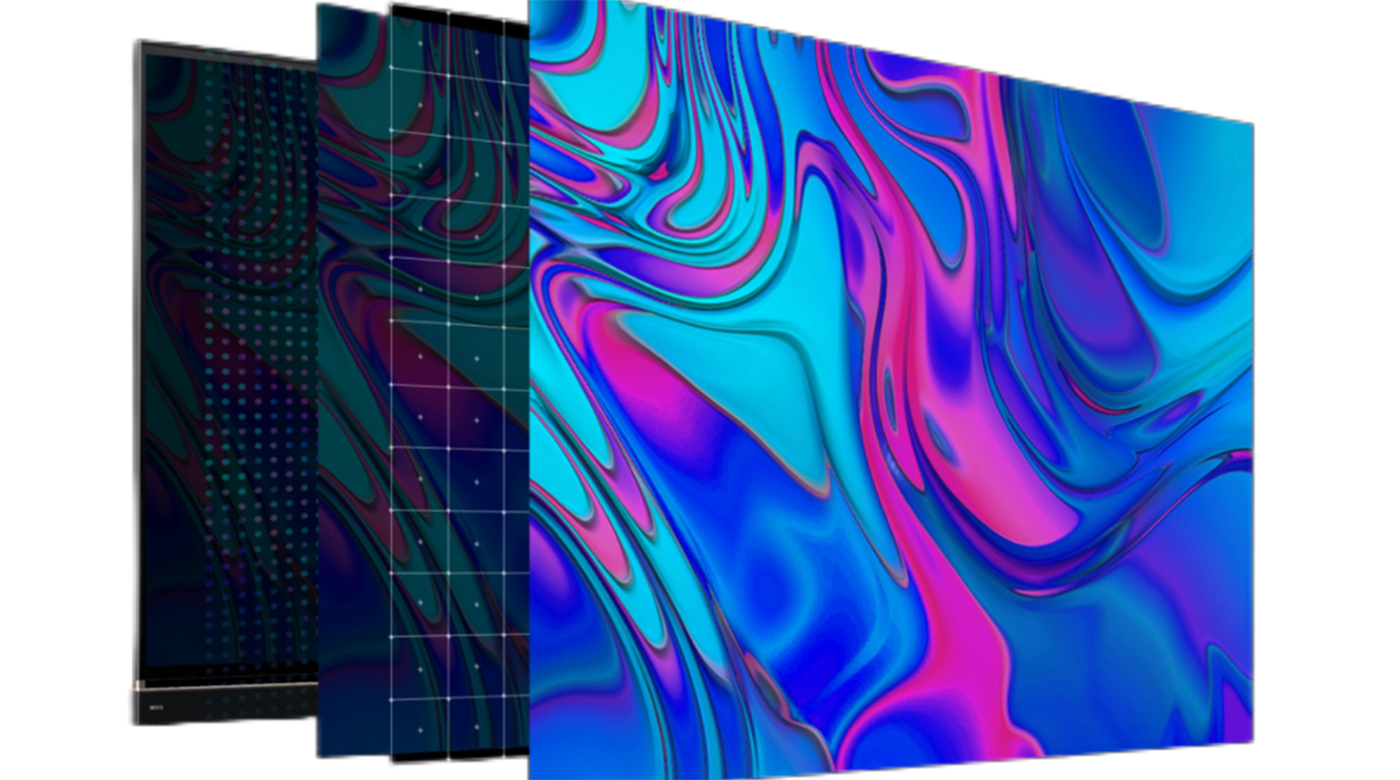
The MicroLED Display Market: 2026 Size, Growth & Consumer Trends
From January 2026 through May 2026, AWALL's research team analyzed data from over 8 market research reports and 6 industry analyst publications to understand the key drivers, growth trajectory, and performance benchmarks shaping the global MicroLED display market. The analysis covers global market valuation from 2020 through 2034 projections, year-over-year growth rates, regional adoption share, application segment breakdown by use case, and direct technology performance comparisons between MicroLED, OLED, and LCD display categories. Primary data sources include Fortune Business Insights,1 Omdia,2 Mordor Intelligence,3 Technavio,4 and Konica Minolta Sensing.5
The Global MicroLED Market at a Glance
The table below maps the global MicroLED display market from its earliest commercial deployments through 2034 projections, with estimated market size, year-over-year growth, and the primary driver behind each phase.
The Global MicroLED Display Market: Size, Growth & CAGR by Year (2020–2034)
| Year | Global Market Size (USD) | YoY Growth | Key Market Driver |
|---|---|---|---|
| 2020 | ~$0.45 billion1 | Baseline | R&D phase; pilot commercial signage installations |
| 2022 | ~$0.80 billion1 | +78%1 | Expansion into luxury home cinema; early commercial deployments |
| 2024 (Est.) | ~$1.15 billion1 | +43%1 | High-end wearable integration; mass transfer technology matures2 |
| 2025 (Est.) | $1.70 billion1 | +48%1 | Consumer inflection point; first commercial MicroLED wearables ship at scale2 |
| 2026 (Proj.) | $2.25 bill ion1 | +32%1 | Ultra-large TV category entry; public display acceleration2 |
| 2032 (Proj.) | ~$6.8 billion*2 | 30% CAGR1 | Mainstream adoption across automotive and large-format displays |
| 2034 (Proj.) | $18.32 billion1 | 30% CAGR1 | Full consumer category maturity across all segments |
Key Takeaways
- Market size is confirmed, not projected speculation: The $1.70B base year valuation (2025)1 and $2.25B 2026 estimate1 come from Fortune Business Insights' April 2026 report update, not a pre-publication forecast. The technology is in commercial deployment, not the pipeline.
- 30% CAGR through 2034 signals sustained, not speculative, growth: The market is projected to reach $18.32 billion by 2034,1 an 8x expansion from the 2025 base. This is a 9-year compounding growth curve, not a one-year spike.
- 2025–2026 is the confirmed inflection point: Market size nearly doubles from 2024 to 20251 as mass transfer manufacturing achieves commercial scale.2 A buyer in 2026 is entering at the moment of widest availability and before mainstream adoption drives pricing upward.
- Two datasets cover different scopes: Fortune Business Insights' total market ($2.25B in 2026)1 and Omdia's sub-segment revenue ($105.4M in 2026 for smart watches and public displays)2 are both accurate but measure different things. The Fortune BI figure covers the total MicroLED display market; the Omdia figure covers MicroLED display product revenue within the smart watch and public display sub-segment.
Where MicroLED Growth Is Happening: Market by Application Segment
MicroLED adoption is not uniform across product categories. The segments driving revenue growth in 2026 differ in size, maturity, and growth rate. Understanding where the technology is gaining traction places large-format home and commercial displays within the correct context of the broader adoption curve.
MicroLED Display Market by Application Segment (2026)
| Application Segment | Est. CAGR (2026–2034) | Dominant Technology Use Case | Primary Growth Driver |
|---|---|---|---|
| MicroLED TVs (75"+) | ~25.5%1 | Home theater; luxury installs | Entry into ultra-large consumer category; 130"+ displays1 |
| Wearable Displays (Smartwatches / AR Glasses) | ~28.2%2 | Near-eye displays requiring high brightness for outdoor AR readability | Garmin fenix 8 Pro shipments;2 AUO Gen 4.5 mass production confirmed 20252 |
| Automotive Displays / HUDs | ~85.0%1 | Head-up displays; dashboard integration | Fastest-growing sub-segment per Fortune Business Insights;1 EV demand for high-brightness, low-power LCD/OLED replacement |
| Digital Signage / Public Displays | ~31.4%2 | Commercial video walls; public transit; storefronts | 24/7 deployment viability; Omdia-confirmed revenue doubling ($52.4M to $105.4M YoY)2 |
| Others (Cinema, Medical, Defense) | ~12.0%3 | Specialist high-brightness applications | Ruggedized display requirements; surgical imaging precision |
Key Takeaways
- Automotive is the fastest-growing segment by CAGR: Fortune Business Insights identifies automotive displays as the fastest-growing MicroLED sub-segment,1 driven by the EV industry's demand for high-brightness, low-power HUD replacements for LCD and OLED. This cross-industry scale accelerates manufacturing improvements that benefit large-format display buyers.
- Large-format TV is the highest revenue-per-unit segment: While wearables lead on unit volume,2 a single 135-inch MicroLED display represents more revenue than hundreds of wearable units. The residential and commercial large-format tier is where per-transaction value is concentrated.1
- 2025 marked the first true commercial MicroLED product shipment: AU Optronics' Gen 4.5 mass transfer line shipped the Garmin fenix 8 Pro,2 the first commercially available MicroLED wearable. This confirmed that mass transfer manufacturing works at scale, removing the primary technical risk that had kept MicroLED out of consumer reach.
MicroLED Adoption by Region: A Global Market Snapshot
Regional market share reflects both where MicroLED is manufactured and where it is being adopted first. Both dimensions matter for a buyer evaluating supply chain stability and the technology's long-term trajectory.
MicroLED Display Market Share by Region (2025 Base Year, Fortune Business Insights)
| Region | 2025 Share | 2025 Value (est.) | 2026 Projection (est.) | Key Adoption Driver |
|---|---|---|---|---|
| North America | 34.50%1 | ~$0.59B1 | ~$0.78B1 | Premium residential TVs; enterprise and retail signage; AR/XR investments |
| Asia-Pacific | 33.60%1 | ~$0.57B1 | ~$0.76B1 | Core supply chain: South Korea, Japan, China, Taiwan; high regional consumer electronics demand |
| Europe | 21.10%1 | ~$0.36B1 | ~$0.47B1 | Luxury automotive HUD integration; consumer electronics; retail display demand |
| Middle East & Africa | 6.60%1 | ~$0.11B1 | ~$0.15B1 | Smart-city projects; advanced commercial display adoption in Gulf states |
| Latin America | 4.10%1 | ~$0.07B1 | ~$0.09B1 | Early-stage commercial and consumer adoption |
Key Takeaways
- North America leads regional share at 34.50%, narrowly ahead of Asia-Pacific at 33.60%: This reflects the premium residential and commercial buyer concentration in North America1 rather than manufacturing volume. Asia-Pacific leads on production capacity; North America leads on demand-side adoption at this stage of the market.
- Asia-Pacific's 33.60% share reflects manufacturing scale, not just consumer demand: The region's share is anchored by Samsung, LG Display, BOE, and AUO production concentration in South Korea, Japan, China, and Taiwan.1 A buyer purchasing MicroLED in 2026 is benefiting from a supply chain backed by the world's four largest display manufacturers.
- Europe at 21.10% is driven by automotive HUD integration: European luxury automotive manufacturers are integrating MicroLED into head-up displays1 at a faster pace than most other regions. That cross-industry adoption accelerates manufacturing refinements that benefit all large-format display buyers.
- MEA and Latin America together represent 10.70% of the 2025 market: Early-stage adoption in these regions reflects the technology's current concentration in premium applications.1 Combined projected value of approximately $0.24 billion in 20261 indicates meaningful but nascent commercial activity.
MicroLED vs. OLED vs. LCD: What the Performance Data Shows
Market size data confirms MicroLED is a credible technology investment. Performance data answers whether it is the right technology for the specific use case. The benchmark comparison below covers the specifications that matter most for large-format display buyers across home theater, commercial, and professional applications.
MicroLED vs. OLED vs. LCD: Key Performance Benchmarks (2026)
| Specification | MicroLED | OLED | LCD / Mini-LED |
|---|---|---|---|
| Peak Brightness | 1,200–2,500 nits7; specialized outdoor-rated models reach higher thresholds | 800–1,000 nits typical consumer5; washes out in high-ambient light | 1,000–2,000 nits typical5; maintained in direct sunlight with anti-glare coating |
| Native Contrast | 15,000:1–30,000:1 native7; infinite dynamic contrast (true black: pixels off produce zero light output with no backlight or substrate) | ~1,000,000:1 marketed ratio measured at single-pixel laboratory level5 | ~5,000:1 native5; local dimming zones approximate deeper blacks |
| Color Accuracy | BT.2020 wide color gamut5; full color accuracy maintained at peak brightness in any lighting condition | High color accuracy at low brightness5; performance degrades under high ambient light | Varies; 72–90% BT.2020 typical5 |
| Energy Consumption vs. LCD | ~90% less energy than LCD5; ~50% less than OLED5 | ~50% less than LCD5 | Baseline (reference point) |
| Burn-In Risk | None: inorganic gallium nitride (GaN) construction5; no organic compounds to degrade | Yes: organic emitter compounds degrade over time under sustained high-brightness use5 | None |
| Lifespan | 100,000+ hours rated5 | 30,000–60,000 hours at peak brightness before measurable luminance degradation5 | 60,000+ hours typical5 |
| Color Bit Depth | 12+ bit standard; 16-bit capable (I-Series advanced models)7 | 10-bit typical consumer; 12-bit in professional broadcast panels5 | 8–10-bit typical5 |
| Self-Emissive | Yes: each pixel generates its own light5; no backlight, no substrate | Yes: each pixel generates its own light5 | No: backlight required; LCD layer modulates light5 |
Technical Summary: Why MicroLED's Advantages Are Rooted in Materials Science
- Energy Efficiency: MicroLED uses ~90% less energy than LCD5 and ~50% less than OLED at equivalent brightness.5
- Lifespan: Rated for 100,000+ hours,5 nearly double that of high-end OLED panels at peak brightness conditions.5
- Burn-In: Structurally impossible due to inorganic gallium nitride (GaN) construction.5 No organic compounds means no organic degradation mechanism.
- Brightness: Peak output of 2,500 nits7 versus 800–1,000 nits for typical OLED consumer panels.5
Key Takeaways
- MicroLED's native contrast advantage is structural, not marginal: OLED's marketed contrast ratios are single-pixel laboratory measurements.5 MicroLED's 15,000:1–30,000:1 native contrast7 reflects whole-panel real-world performance. When pixels are off, they produce zero light output with no backlight bleed. The practical difference is visible in dark cinematic scenes where OLED blooming is most pronounced.
- 90% less energy than LCD translates directly to operating cost savings: For a commercial installation running a display 16+ hours per day, Konica Minolta Sensing's documented 90% energy reduction versus LCD5 is a measurable total cost of ownership advantage over the deployment lifespan. For residential buyers, lower energy draw also means less heat output, eliminating the supplemental cooling that high-lumen traditional displays require.
- 100,000-hour lifespan reframes the purchase as a long-term investment: At typical viewing hours, a 100,000-hour MicroLED lifespan5 represents decades of use. OLED's 30,000–60,000-hour rating at peak brightness5 places meaningful degradation risk within a 10–15-year window at high-use commercial deployment schedules.
- Zero burn-in is a function of materials science, not a marketing claim: MicroLED uses inorganic gallium nitride emitters.5 There are no organic compounds to degrade. The burn-in risk that exists with OLED is structurally absent from MicroLED, regardless of content type or display duration.
MicroLED Display Revenue: Year-Over-Year Acceleration (2025–2026 and Beyond)
Beyond multi-year market projections, 2026 marks a measurable single-year acceleration event in MicroLED display revenue, documented by Omdia's Micro LED Display Market Tracker.2
| Metric | 2025 | 2026 (Projected) | YoY Change |
|---|---|---|---|
| Total MicroLED Display Revenue | $52.4 million2 | $105.4 million2 | +101% (doubles year-over-year)2 |
| Primary Growth Segments | Smart watches (Garmin fenix 8 Pro)2; public displays2 | Smart watch volume ramp2; public display deployments; ultra-large TV category entry2 | Manufacturing scale for mass transfer achieved2; first commercial consumer products shipping2 |
| Key Manufacturing Milestone | Mass transfer yield challenges remain; limited commercial products2 | AUO Gen 4.5 mass transfer line achieves commercial production2; Samsung, LG begin TV-tier production2 | Technology crosses from prototype/commercial-signage-only to multi-segment consumer products2 |
| Long-Range Projection (Omdia) | N/A | $105.4 million (2026)2 | Projected to reach ~$6.8 billion by 20322; representing ~4.4% of total flat panel display market2 |
Key Takeaways
- 101% YoY revenue growth is documented, not modeled: Omdia's Micro LED Display Market Tracker is a primary analyst data product, not a summary or aggregation. The $52.4M to $105.4M figure2 is a tracked revenue measurement with a named analyst and a February 2026 publication date. It is one of the strongest citable data points in this analysis.
- The doubling is driven by real product shipments, not pipeline projections: Two specific manufacturing events explain the acceleration: AU Optronics' commercial mass transfer line for wearables2 and Samsung's entry into TV-tier large-format production.2 Revenue is doubling because products are actually shipping, not because analysts revised their models upward.
- This sub-segment figure ($52.4M / $105.4M) is not the same as total market size: Omdia's tracker covers MicroLED display product revenue.2 Fortune Business Insights' $2.25B total market figure1 uses a broader definition including components, IP, and adjacent technology. Both are correct within their scope.
- $6.8B by 2032 is the long-range Omdia projection for this same sub-segment: That trajectory, from $105.4M in 20262 to $6.8B by 2032,2 represents a 64x increase in six years within the product revenue sub-segment alone. It is the most concrete signal that 2026 is genuinely early in the market's adoption curve.
Micro-led Display Market: What The Data Means for MicroLED Buyers in 2026
The market data across every dimension studied tells a consistent story. MicroLED is past its proof-of-concept phase. It has a 30% CAGR through 2034,1 a global manufacturing supply chain with commercial-scale production confirmed in 2025,2 a performance profile that objectively outpaces OLED and LCD on native contrast, energy efficiency, lifespan, and color accuracy,5 and a specific 2026 revenue inflection point backed by real product shipments and independent analyst data.2 The remaining barrier for most buyers has been pricing: MicroLED has historically been available only through quote-based dealer channels, with entry points that placed it out of reach for consumers who were not already working with luxury integrators.13
AWALL's CoB MicroLED Display earned Best of Show recognition at both InfoComm 20258 and CEDIA 20259, the two benchmarks professional integrators use to evaluate the highest tier of residential and commercial AV. AWALL's C-Series Chip-on-Board (CoB) MicroLED displays start at $19,25007 with published pricing and no dealer intermediary. See specs and pricing at awall.com.
References
- Fortune Business Insights. Micro-LED Display Market Size, Share and Industry Analysis Report. Last updated April 27, 2026. fortunebusinessinsights.com/micro-led-display-market-114268
- Omdia. Micro LED Display Revenue to Double to $105 Million in 2026 Driven by Near-Eye Smart Watch and Public Display Applications. February 19, 2026. businesswire.com/news/home/20260219980076/en/
- Mordor Intelligence. Display Market Report (includes MicroLED CAGR reference). February 2026. mordorintelligence.com/industry-reports/display-market
- Technavio. Micro LED Display Market Growth Analysis, Size and Forecast 2026–2030. January 2026. technavio.com/report/micro-led-display-market-industry-analysis
- Konica Minolta Sensing. Pushing the Limits of TV Displays with MicroLED Provides No Boundaries. sensing.konicaminolta.us/us/blog/pushing-the-limits-of-tv-displays-with-microled-provides-no-boundaries/
- AWALL product specifications and pricing. awall.com. Verified May 2026.
- AVNetwork. Winners Announced: Best of Show at InfoComm 2025 for AV Technology. June 12, 2025. avnetwork.com/news/winners-announced-best-of-show-at-infocomm-2025-for-av-technology
- Residential Systems. 2025 CEDIA Expo Best of Show Winners Announced. September 6, 2025 (updated September 9, 2025). residentialsystems.com/events/awards/2025-cedia-expo-best-of-show-winners-announced


Leave a comment
This site is protected by hCaptcha and the hCaptcha Privacy Policy and Terms of Service apply.